The purpose of this assignment is
to help you
1) to help you locate web sites that have useful information
for biology students.
2) to introduce you to cell biology
Type your answers (1, 2, 3...). Do not rewrite the questions.
Look at the apoptosis movie to answer questions 1-3 below (http://www.cellsalive.com/apop.htm)
1. Describe in your own words the physical change
you see in cell undergoing apoptosis.
2. Why would you want to control apoptosis in cancer?
3. Why would you want to control apoptosis in strokes?
Look at(the 1 MB movie
of) Dictyostelium and use your text book to answer questions
4-6.
4. Is the cytoskeleton rigid like the vertebrate skeleton?
5. What is Dictyostelium (See Lab
1 help page)?
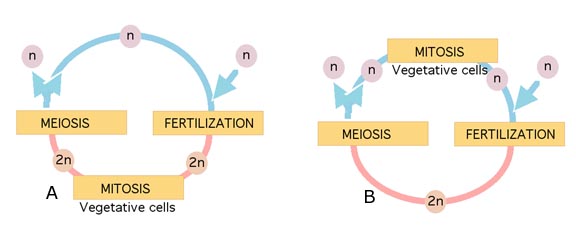
6. You used a slime mold (Physarum) in Lab Experiment
1. Which life cycle represents the life cycle of Dictyostelium?
(The other one must be Physarum.)
7. PubMed is an index to articles published in medical and scientific
journals maintained by the National Library for Medicine. Check
out PubMed
(choose the PubMed database) by looking for an article on a disease
associated with the cytoskeleton. Give the article citation in
the proper format. Note, that
PubMed is an index--the articles are published in peer-reviewed
journals, not in PubMed.
For questions 8-12. Information science has been applied to biology
in the field of bioinformatics. The National Center for
Biotechnology Information (NCBI) creates public databases for
storage and organization of the vast amount of information available
on proteins and genes. Genomic maps are published in a database
called BLAST (Basic Local Alignment Search Tool). Go to the Map
View for Homo sapiens in BLAST
8. What is the longest chromosome?
9. How many different human nuclear chromosomes are there?
10. What's mt?
11. Remember bey1, bey2, and gey; for what do they code? Type each in the Search box. What chromosomes are they on?
12 The protein 53 (p53) gene is a tumor suppressor gene, i.e.,
its activity stops the formation of tumors. If a person inherits
only one functional copy of the p53 gene from their parents, they
are predisposed to cancer and usually develop several independent
tumors in a variety of tissues in early adulthood. However, mutations
in p53 are found in most tumor types, and so contribute to the
complex network of molecular events leading to tumor formation.
type ' 53 gene' in the Search Box. On what chromosome is the p53
gene located?
13. The protein encoded by p53 has 393 amino
acids. Mutations would change one or more amino acids. A DNA array
can be used to detect the specific mutation in a patient. What
is the value of knowing the specific mutation in a patient's cancer
cells?
For questions 14-16. Assume you have isolated a protein and
sequenced the amino acids in that protein. The amino acids are
abbreviated by single letters (Amino
acid code). (FASTA is a way of writing proteins and nucleic
acids in one letter codes that work in any language. FASTA stands
for Fast All.) Use BLAST
to see if this protein is known and what its function is. Go to
BLAST home. Select Protein BLAST. Copy and paste the following
into the FASTA Search box. Then click the blue
BLAST button at the bottom of the page.
ETLMEYLENPKKYIPGTKMIFAG
When the results are tabulated,
14. What is the protein?
15. Provide a one-sentence description of the function of this
protein.
16. Click on Taxonomy Reports. What other types of organisms
have this protein?
For questions 17-19. Return to Protein BLAST, Copy
and paste the following into the Search box. Then click the BLAST!
button at the bottom of the page.
18. How does this amino acid sequence differ from
the one above?
19. What disease is caused by this protein?
20.You isolated this oligonucleotide (short piece of DNA) in your milk: cacaccaccgcagcgaatct Use Nucleotide BLAST to identify the organism that left it there?
21.Look at the sporangia in the video. In your own words describe what the zoospores
do when released from the sporangium?
22. Browse the sites on careers
in biology. What new career(s) did you learn about?
23. Identify (or come as close as you can to) this cell.
24. Identify (or come as close as you can to) this cell.
25. Identify (or come as close as you can to) this cell.


 BIOL
230 lab contents
BIOL
230 lab contents